When I learned about lead in tile, both ceramic and porcelain, I immediately thought of the kitchen and bathroom renovations we did with a toddler living in our home. I felt SICK. And then, I felt angry. Angry at our contractors for not knowing and/or not advising us of the risks (they also didn’t test for lead paint, an egregious violation we didn’t know about at the time). Angry that this is not common knowledge and that millions of kids are likely exposure to lead via tile demolition (or lead dust coming home on the clothes of parents who work in construction). Angry that leaded tile continues to be installed in homes across the United States.
Yes, contrary to what some may tell you, lead glazed tile can be found in homes of any age.
So where is the lead? Glad you asked. For ceramic tile, the glaze is whatever the colorful layer is on top of the tile. There’s no way to know if the tile has lead unless you test it. Generally the tile becomes hazardous in three ways: when cut and installed, in heavily trafficked areas where the glaze is wearing away, and most importantly, during demolition.
Here’s how I tested my ceramic tile:
1. I had a licensed lead inspector come over and scan the file with an XRF machine. For one type of tile the results were somewhere between 1.2-1.6 micrograms per centimeter squared. Paint counts as lead based, according to the EPA, if it is 1 microgram per centimeter squared, which equals around 5000ppm lead. The other tiles in our home did not register any lead—however, a more sensitive XRF machine may pick up lead in them at lower levels.
2. I sent a piece to an EPA accredited lab to be tested for lead. I don’t remember the results but basically the tile had lead. This is not the method to use. It gives an incomplete result about the amount of lead in the glaze, because they are measuring the total amount of lead in the piece of tile, which is diluted by the ceramic.
3. I demolished two pieces of tile and did dust wipe samples of the surface of the tile to see what the lead dust levels may be. The results were around 32 ug/sqft and 13 ug/sqft, both of which are over the recommended standard for lead dust floor clearance of 5 ug/sqft.
Basically, we have a problem on our hands when we need to replace the tile.
After speaking with two lead abatement professionals, we determined that the cost will be astronomical. We were advised not to be living in our home when we remove the tile, and basically to move all our things out of the home so they don’t get contaminated—especially soft furnishings. We are not to move back IN to our home until we’ve thoroughly cleaned and tested the home for lead dust.
So, yeah that sucks. But what sucks even more are the stories I’ve read of kids being poisoned during home renovations from tile demotion. I actually saw a post from one mom who said her family moved into a new home and her son was poisoned from lead dust in her master bedroom carpet, left over from when the previous owners renovated their bathroom.
Really makes you wonder.
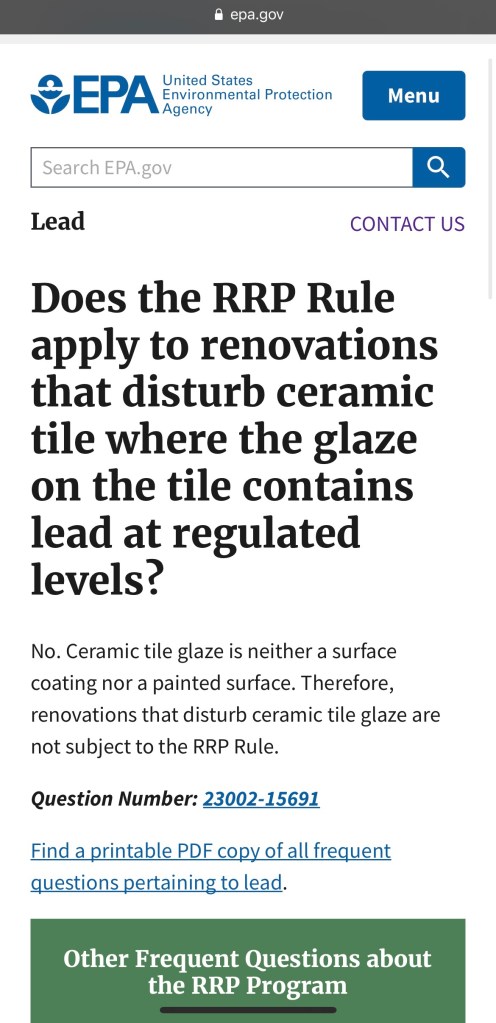
So what are the laws around lead in tile? I have no idea. I can tell you that the EPA basically says that ceramic tile is not covered under the RRP rule—the regulation that says contractors have to follow certain procedures in older homes (spoiler alert: most contractors don’t give a shit about this rule and don’t think lead is a thing). At the very least the RRP rule is unclear about tile.
What should you do?
Either have your tile tested with an XRF by a professional or assume that it’s leaded and treat it as such. While you are testing, test your bathtubs and porcelain sinks. Bathtubs can be a source of lead exposure for kids. Despicable, right?
And if your wheels are turning, and you’re starting to wonder about glazed ceramics in general…yes ceramic dishes and mugs often have lead in them, and the FDA says that is okay as long as they only leach a little bit of lead into your food. Insanity! More on that later…
Until recently I was very naïve about Amazon, specifically, and product safety in general. I avoided sketchy listings, but I didn’t fully appreciate how Amazon works. Like most people, I trusted that products were generally “safe” and the listings legitimate. I’m a smart enough person. But when I really started using Amazon regularly, I was a new mom who was tired, struggling, and just trying to get by. If a product had a lot of reviews, and didn’t seem particularly strange, I was comfortable.
In the past six months I started to gain an appreciation for how Amazon works. I asked my husband a lot of questions about third party sellers, Amazon listings, etc. I had really lost touch with how the internet works while I was trying to raise a human and not working.
Anyway, it doesn’t take much searching to find bad press for Amazon:
A Wall Street Journal investigation found 4,152 items for sale on Amazon.com Inc.’s site that have been declared unsafe by federal agencies, are deceptively labeled or are banned by federal regulators—items that big-box retailers’ policies would bar from their shelves. Among those items, at least 2,000 listings for toys and medications lacked warnings about health risks to children.
Amazon Has Ceded Control of Its Site. The Result: Thousands of Banned, Unsafe or Mislabeled Productsvia the WSJ, 2019
Skip to 7:26 to listen to a former Amazon employee, who worked in compliance and product safety, talk about her experience trying to convince Amazon to put infant safety first when 2 million drop-sided cribs were recalled.
Said husband pointed out to me that 4,152 unsafe items out of the bajillion listed on Amazon is a tiny fraction. But, that’s just what they found, I told him. Once I started poking around, I grew increasingly weary of Amazon and third party seller marketplaces. Why did I assume all these listings were somehow vetted and deemed legitimate? I had completely bought into the illusion of safety in online shopping.
Safety is important to me. I want to know my kid’s toys have been safety tested. I want to know their clothing, furniture, and school supplies are safe. What happens when toys are not tested? Well you might get magnets or batteries that fall out and pose a huge hazard to little kids. Or lead paint. Laceration risks. Dangerous small parts. Furniture tip overs. Inclined sleeper associated deaths. I’ve been challenged with a lot of, “Why do products need safety testing? It’s expensive for companies. It hurts small businesses!” If you don’t want to buy safety tested products, then don’t. But don’t rain on my product safety parade.
If you’re curious about product safety for kids toys, I have some links on my resources page.
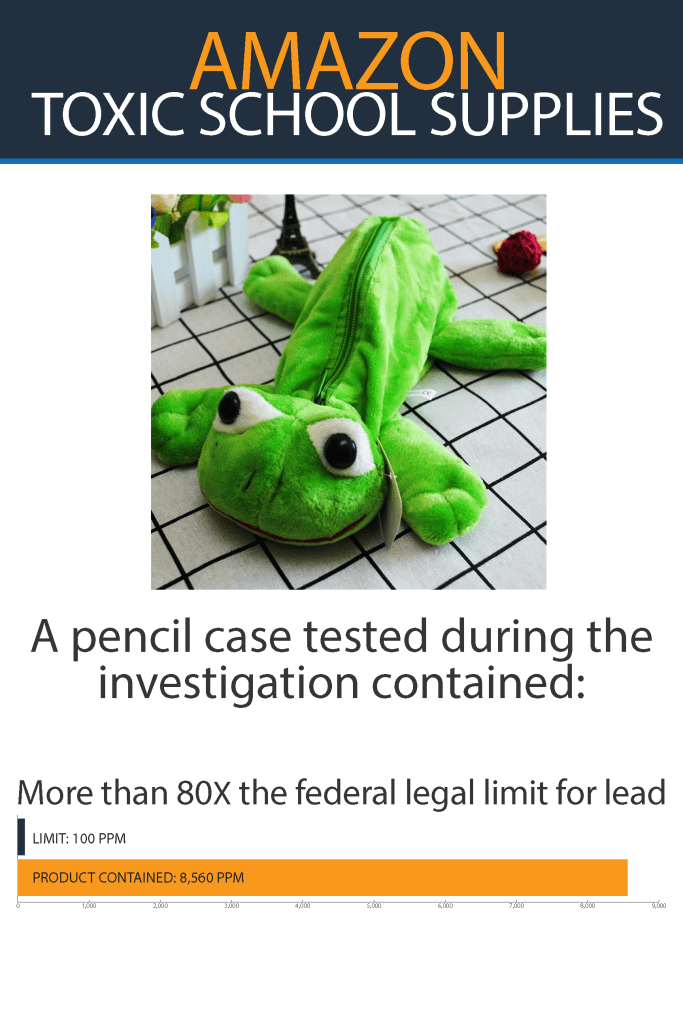
Here’s a recent example of Amazon getting into some trouble for being the platform for the sale of unsafe school supplies. In 2019, Attorney General Bob Ferguson from Washington state announced that Amazon agreed to block the sale of children’s school supplies and jewelry on Amazon.com without proof of safety testing after his office found high levels of toxic metals in school supplies sold on the site.
I can’t find a CPSC recall on any of these items, and wonder how many consumers actually knew about these recalled items. My guess is that a lot of these items are still in circulation, which is scary considering one of the items, an innocuous looking frog pencil case, tested at 80 times the limit for lead, at 8,560ppm.
The Seattle Times wrote:
Even after Amazon was notified of the illegal children’s products and said it had removed them, investigators found some of the same products again, as well as others that contained the metals at levels well beyond the legal maximum.
So this is where I start to have even bigger problems with Amazon. What systems were or are in place to prevent sellers from re-posting recalled or banned items? Who is vetting these items? What listings can I trust on Amazon at this point?
There are plenty of legislators who are on Amazon’s case for pretty much everything, you name it. Most pertinent to this post, Senator Dick Durbin (D, Illinois) and Senator Bill Cassidy (R, Louisiana) introduced legislation in 2020 to address third-party seller issues.
The INFORM Consumers Act directs online marketplaces to verify high-volume third-party sellers by acquiring the seller’s government ID, tax ID, bank account information, and contact information. High-volume third-party sellers are defined as vendors who have made 200 or more discrete sales in a 12-month period amounting to $5,000 or more.
The legislation instructs online marketplaces to order their high-volume third-party sellers to disclose to consumers the seller’s name, business address, email address, phone number, and whether the seller is a manufacturer, importer, retailer, or a reseller of consumer products.
Great but what about all the lower volume sellers? Legislation like this could be misleading to consumers, in my opinion. How are consumers supposed to know which sellers are covered by this law? Or that this law even exists? Most people don’t pay attention to these issues. They’re trying to LIVE. Who has time for extensively vetting everything they buy? The answer: almost no one. Not to mention, there’s no real way to actually vet anything. Companies and manufacturers don’t have to prove anything to consumers, or share safety testing reports, etc. Consumers have limited means to evaluate products.
Online shopping is mostly a leap of faith.
UPDATE: Amazon (and others) successfully lobbied to keep the Inform Consumers Act out of a bipartisan bill to counter China’s global rise. It was included because much of the problematic merchandise on Amazon comes from China. Including fake COVID-19 vaccination cards.
More recently, Amazon blocked a ton of fake stuff from being listed. Like 10 billion listings. Which is great, but doesn’t make me want to shop there. I could go on and on about Amazon, like how they are pushing back on legislation to force online retailers to indicate where things are made. The fact is it’s the Wild Wild West on there, a lot of cheap, possibly unsafe products from China, and I’m not comfortable with it. I’m taking my money elsewhere, as much as I can.
There’s also their treatment of workers, Jeff Bezos as the new Lex Luther, and a whole bunch of other reasons to not frequent Amazon. This guy is going to space and buying a $500 million yacht, when he could probably do a lot of good with his ill gotten fortune–if he gave a shit.
How Jeff Bezos isn't surrounded by an angry mob at all times is beyond me.
Ultimately, I concluded I’m not particularly comfortable shopping at Amazon anymore.
But I still shop there, sometimes. Mostly for books, if I can’t find them elsewhere. Never for kids stuff (clothes, toys or otherwise). I do shop at Whole Foods. We have Ring. It feels impossible to completely escape Amazon, as the internet can attest to, but I try. I’m not alone. Other’s have tried to quit Amazon, and found it to be impossible.
One thing that has been especially difficult is trying to keep questionable Amazon products gifted from others out of my home. Birthday party favors, school prizes, toys and gifts for my kids…how do you tell everyone in your life, please don’t buy us random third party stuff from Amazon, I don’t trust it? Haven’t figured this one out yet. One solution was to make our own prize bag for trade-ins when something super questionable comes home. Which can be a massive bummer for kids who want to be a part of things with their peers. I manage some of this by staying informed of toy recalls and keeping an eye on CPSC data. And just letting my kid keep some stuff for awhile until it’s time to purge the toys.
And, sometimes finding a product in an actual store, OR sold directly from a brand like Target (instead of a third party seller) proves impossible. Walmart and Target both have their own third party seller marketplaces to worry about.
For now, I choose to not buy from third party sellers. I try to buy direct from companies, in person if possible. If I shop on Target.com, I make sure I’m buying from Target–not that it’s any guarantee, but it makes me feel some reassurance I guess.
Ultimately everything is “buyer beware”. So, I’m wary. We can’t wait for regulations. Too many people are against regulations. It’s not the path. And in my opinion, we can’t trust companies to do the right thing either. See: Fisher-Price inclined sleepers. I’d love to see consumers, especially parents, use their money in ways that shift the market. This calls into question a lot of issues about privilege–not everyone can afford to buy expensive wood toys and locally made organic onesies. For those of us with privilege and access, I believe we have an obligation to advocate for and purchase safe products, from responsible retailers, and to demand better for ALL kids.
Parents have a lot more power than they think. We need to start using it.
By the time I became pregnant with my second child I had essentially forgotten how to be pregnant or care for a baby. In just over five years a lot had changed.
The first thing I learned was that the prenatal vitamins I took with my first baby had a heavy metals (lead) related lawsuit. I barely knew what heavy metals were. A few hours of googling about lead and I was a puddle of regret and fear. I wondered what else I didn’t know, so like a true idiot I joined a few Facebook groups and started browsing Reddit. This path is not for the faint of heart.
Fueled by hormones, pandemic isolation, and utter panic I found myself completely paralyzed by the information I found. How did I not know this stuff? I should have known! How could I be such a shit mom?
In the past when people would bring up non-toxic living I would think, “Whatever, we’re all being poisoned all the time.” I was happier then. Now, everyday items seemed dangerous. I couldn’t believe all the sneaky places heavy metals and dangerous chemicals were hiding. I’d go into these Facebook groups looking for safe product suggestions, and come away confused, frustrated, or empty handed because the solutions offered in the group just didn’t fit for me and my family. I’m lookin at you buckwheat pillows.
Months and months of research followed. I couldn’t choose a baby product to save my life. Taking my prenatal vitamins gave me anxiety. I worried my family and friends. I annoyed them. I was grateful we couldn’t leave the house. Things got pretty weird.
I tried to tackle the big stuff, the little stuff, and the medium stuff. I got overwhelmed. I threw out a ton of our stuff, tried to clean up our personal care products, had our water tested and still barely made a dent. I tried to find “safe” toys for my kid, and found it a herculean, expensive task. I spent a lot of time trying to convince my family that my concerns were valid. That part sucked especially hard. I felt very alone sometimes.
The good news is now I’m mostly just angry! I want to go to Target and not wonder if the toy I buy my kid is going to be recalled in a few months, or worse hurt or poison said kid. I want transparency from companies so I can make decisions for my family. And not vague Prop65 warnings. I want to see safety reports and ingredients lists. My husband likened it to nutrition labels on food. Some people read the labels, and some don’t. I want the labels because I will read them. If you don’t want to read them, you don’t have to! But I want to know if there’s lead, and how much, in my kid’s toys. And whether there’s cadmium in my baby’s silicone teether. And whether the baby bottle I bought has swapped out BPA with a “regrettable substitute”.
I’ve collected a ton of resources, research, and random knowledge that I want to share. The months of self-inflicted misery can’t be for nothing. I hope to cover children’s environmental health, product safety, public health, decision making, activism, mental health and whatever else I find in my extensive collection of Google chrome bookmarks. There will be yelling, mostly into the void, and calls to action.
What I don’t plan to cover is product recommendations. You won’t find me reviewing labels and determining if a product is safe. There’s an army of moms out there doing that research and they are very, very good at it. I’m not there yet.
Make no mistake, I admire these non-toxic moms, with their wooden toys, no shoe rules, and non-toxic cleaning products. They make their own yogurt! They only use glass! Their floors are finished in beeswax! And many of them don’t vaccinate, or use fluoride, and they seem to mostly see naturopaths and functional medicine providers. My kids are vaccinated, we use fluoride, and we see mainstream doctors. I also eat Burger King. I don’t fit in these communities in a lot of ways, but I am grateful for their tireless, extensive research and commitment to their children’s safety and health, and that of the planet. I owe much of what I have learned to the Internet’s Non-Toxic Moms.
I’m just a regular mom, learning about this stuff and trying not to freak out.
I won’t talk much about my family. You won’t see pictures of my kids. I will not write recipes and do “how to” videos. I will swear. I will not do Tik Tok dances. I will try to be funny, but sometimes I will be sad because…the world.
Mostly I hope to provide good information to what I assume will be my immediate family, because who else is going to read this.


 Kinda NonToxic